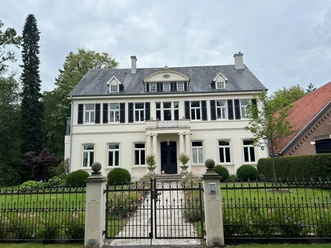
Hof Kleiberg


The History of the Farm
There were eight tenant farms, whose origins can still be traced by name in old records today, thus providing insight into the settlement of the village of Wiefelstede. The tenant farmers had settled in the immediate vicinity of the church and on the Brink. Over the course of the following centuries, the Köter, Brinksitzer, and Heuerleute joined them, gradually settling the Esche.
This included the long-established Küpker family on their farm on the Kleiberg.
But as the village continued to develop, many farms found the village too cramped. Thus, in 1970, the Küpker farm was relocated and has been operated in Hellermoor ever since. The property with the old buildings became the property of the municipality, which needed a new location for its public works yard.
For nearly two decades, the employees set out from there to carry out the necessary work on public facilities and infrastructure within the municipal area, thereby ensuring a well-maintained appearance.
However, the scope of the work to be carried out by the public works yard grew steadily over time, so that the diverse tasks could only be fulfilled satisfactorily and cost-effectively with a new building on Stahlstraße. The old buildings on Kleiberg were thus available for other uses.
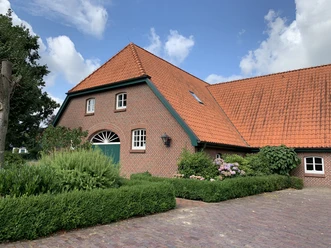
The activities of the Wiefelstede Local Citizens’ Association (Ortsbürgerverein Wiefelstede e.V.) had also expanded considerably, and the desire for a dedicated clubhouse grew ever stronger. Naturally, the old municipal works yard presented itself as the ideal solution. What had initially seemed like a rather bold idea had taken root in the minds of those involved. Countless meetings followed, during which the possibility of realizing a village community center was discussed. Everything that needed to be clarified, agreed upon, arranged, and applied for in the run-up to such a project was finalized in the first half of 1991.
The municipal administration was finally able to give the green light for construction to begin, which then kicked off on August 24, 1991, with the removal of the roof tiles from the barn. The local civic association had committed to providing extensive volunteer labor.
The construction work had become a cause for the entire village community. Many members of the local civic association, as well as other organizations, the volunteer fire department, companies, and many individuals worked tirelessly and selflessly for the common cause in the months that followed.
With justifiable pride, Chairman Edzard Pauly was able to present the highly successful project as the “work of the century” for the village of Wiefelstede at the official dedication on December 11, 1992.
On January 23 and 24, 1993, the clubs and the local community were able to take a look at the new “Haus des Gastes.”
In the months that followed, the building came to life. The local civic association’s various groups held their regular meetings there, and the marching band also found a new home there.
Whether sitting on familiar wicker chairs at heavy wooden tables beneath the “Hillen” (sheds) filled with old tools, or gathering around the open fireplace, there are always opportunities for stimulating conversations at the Haus des Gastes, which also serves as a cozy community center.
Until 2008, the Wiefelstede Tourism Association (Touristik Wiefelstede e.V.) was also housed in the Haus des Gastes. After it moved to City Hall, it became necessary to adapt the building’s name to reflect its actual use. In October 2009, the local civic association launched a survey among residents, which received a great response and yielded a large number of name suggestions. The new name was then announced at the New Year’s reception on January 17, 2010. The former “Haus des Gastes” is now called “Hof Kleiberg.”
(Partial excerpt from “50 Years of the Wiefelstede Local Citizens’ Association” by Wilfried Harms)
Good to know
Openings
- Opening hours depend on the events taking place and vary from case to case.
Eligibility
Bad Weather Offer
for familys
Contact person
Ortsbürgerverein Wiefelstede e.V.
Ms. 1. Vorsitzende Dana NeumannKleiberg 1026215 WiefelstedeLicense (master data)
Gemeinde Wiefelstede